California material comparison

Roofing Materials for California Homes and Commercial Roofs

The right roofing material depends on roof slope, deck condition, drainage, energy-code path, wildfire exposure, coastal or inland climate, and whether the scope is repair, replacement, reroofing, or qualified restoration.

Start with the roof geometry

Material selection starts with how the roof moves water. A steep-slope field, a low-slope section, and a coating restoration candidate are different roof problems even when they are on the same building.

Steep-slope roofs

Asphalt shingles, concrete and clay tile, and many metal systems are primarily water-shedding choices for sloped residential roofs.

Low-slope roofs

TPO/PVC and modified bitumen are the main low-slope and commercial paths when waterproofing, drainage, seams, and rooftop equipment drive the work.

Mixed-slope roofs

Porch tie-ins, additions, patio covers, and roof-to-wall transitions often need a membrane detail where the main roof material changes slope.

Restoration candidates

Coatings belong only on existing roofs that are dry, stable, compatible, repairable, drainable, and still worth preserving.

California project filters

What changes the material recommendation?

California's 2025 Energy Code applies to permit applications filed on or after January 1, 2026. Cool-roof compliance is not a generic "white roof" rule; it depends on project type, slope, roof area, climate zone, product ratings, and compliance path.

Code and wildfire details should be confirmed with the local building department, the California Energy Commission, and applicable fire/WUI guidance such as CAL FIRE home hardening.

Master comparison matrix

Use this as the fast scan before reading each material block. The goal is to compare system behavior, not just brochures or material names.

Comparison point Architectural asphalt shingles Concrete and clay tile Standing seam and exposed-fastener metal TPO and PVC single-ply Modified bitumen and coatings
Primary roof geometry Steep-slope residential; not a low-slope solution. Steep-slope water-shedding tile assembly; very low slopes need membrane logic first. Profile-specific; standing seam and exposed-fastener panels should be evaluated separately. Low-slope commercial or commercial-style roofs. Low-slope roofs; coatings only for qualifying existing roofs.
Best-fit project Cost-conscious residential reroof or repairable steep-slope assembly. Appearance-sensitive, long-term residential roofs where the structure supports tile. Standing seam for concealed-fastener performance; exposed fastener for simpler utility uses. Low-slope replacement or recover planning with welded seams and rooftop equipment. Modified bitumen for layered reroof assemblies; coatings for qualified restoration.
Water-control logic Shingles shed water; underlayment, valleys, drip edge, flashings, and ventilation complete the system. Tile sheds water; underlayment, battens, flashings, and drainage beneath tile are decisive. Panels shed water; seams, clips or fasteners, closures, trims, and expansion details matter. Membrane waterproofing; seams, flashings, drains, edge metal, and walk pads drive performance. Modified bitumen uses layered membranes; coatings protect a compatible existing roof.
Big limitation Low-slope transitions, heat-aged details, poor ventilation, old deck/sheathing, and flashing failures. Weight, underlayment age, slope limits, broken/slipped tile, walking damage, and hidden leaks. Fastener/washer maintenance, expansion, corrosion, oil canning, and profile selection. Poor weld prep, rooftop traffic, punctures, clogged drains, short curbs, and bad tapered drainage. Wet roofs, leaks, failed substrates, poor drainage, bad adhesion, ponding, and spent roofs.
Lifecycle tradeoff Lower initial cost and repairability, with strong dependence on details and ventilation. Long-lived visible covering, but underlayment and flashing lifecycle must be budgeted. Potentially long service life, but exposure, fastening method, and profile change maintenance. Efficient low-slope system, but seams, details, and maintenance access are critical. Layered and serviceable; coatings extend life only when qualification criteria are met.
Maintenance expectations Inspect pipe boots, valleys, flashing, gutters, skylights, edges, ventilation, and damaged shingles. Inspect broken tiles, slipped tiles, valleys, debris, bird stops, skylights, solar penetrations, and underlayment symptoms. Inspect fasteners, clips, seams, trim, closures, penetrations, corrosion, and gutters. Inspect seams, drains, scuppers, edge metal, curbs, walk pads, equipment, and contamination. Inspect cap sheets, seams, drains, coating adhesion, wear, thickness, drainage, and punctures.
California code notes Cool-roof review may apply on qualifying reroofs; CRRC-rated product data can matter. Structural/load and appearance review may matter; fire-rated assembly review is not just tile selection. Reflective finishes may help, but metal alone does not equal code compliance. Low-slope reflectance, insulation, drainage, and alteration rules can be central. Recoating can trigger energy-code rules when alteration thresholds apply.
Climate-fit emphasis South Bay heat and ventilation; Peninsula moisture; inland dry-season detail aging. Peninsula moisture below tile; South Bay appearance; inland heat-aged underlayment. Coastal corrosion and inland thermal movement need separate review. Sacramento heat and drains; East Bay/Peninsula perimeter and equipment details. Inland heat/UV and drainage; coast-influenced moisture screening; East Bay debris and tie-ins.

System details

The details matter as much as the material

Accessories, gutters, skylights, ventilation, drainage, walk pads, curbs, and low-slope tie-ins are roof-system details. They should be planned inside the material decision, not treated as separate material pages.

Flashings and underlayments

Valleys, sidewalls, headwalls, chimneys, parapets, low-slope tie-ins, and roof-to-wall transitions usually matter more than the center of the roof field.

Fasteners and attachment

Nails, clips, screws, plates, washers, and substrate penetration have to match the material, slope, wind exposure, and manufacturer instructions.

Ventilation and heat

Attic intake/exhaust balance, hot roof surfaces, and dry-season heat influence shingles, underlayments, sealants, and some metal or low-slope details.

Gutters and drainage

Runoff, outlets, scuppers, drains, overflow paths, fascia transitions, and debris loads must be planned with the roof system instead of after it.

Skylights, curbs, and penetrations

Skylights, sun tunnels, pipe boots, HVAC curbs, pitch pans, solar attachments, and roof access points need primary and secondary water-control thinking.

Traffic and service access

Low-slope roofs and equipment-heavy buildings need walk pads, service paths, puncture review, and maintenance access before the new roof is treated as complete.

Steep-slope residential

Architectural Asphalt Shingles

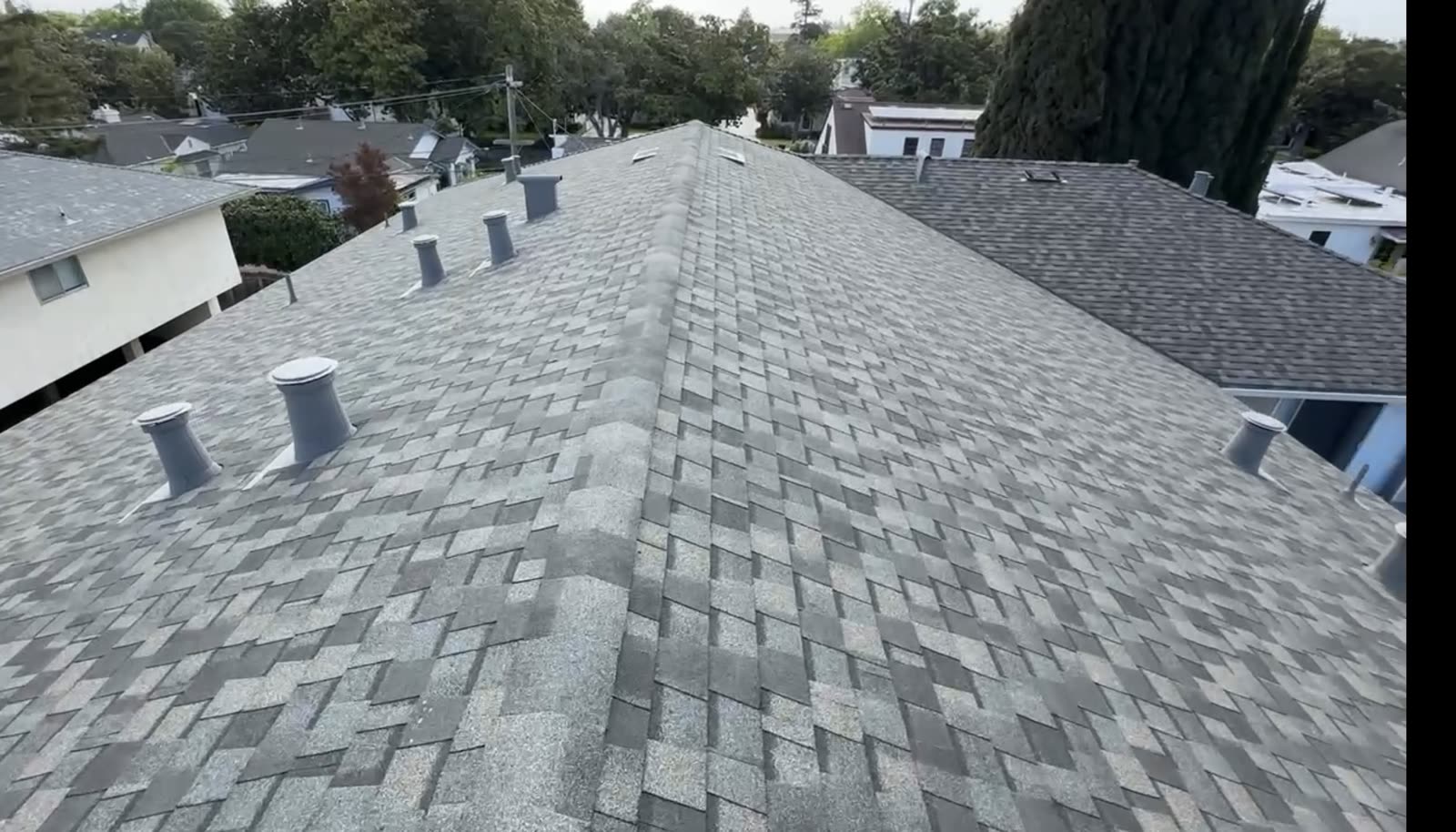
Architectural asphalt shingles are a steep-slope residential roof covering, but the useful comparison is the whole assembly: deck, underlayment, leak-barrier strategy, starter, field shingles, ridge components, ventilation, flashings, gutters, and penetrations.

Architectural asphalt shingle roof with valleys and roof edges

Best-fit projects

  • Cost-conscious residential reroofs where the roof has conventional slopes, valleys, penetrations, and attic ventilation that can be reset during the project.
  • Homes where repairability, product availability, and clean replacement planning matter more than premium tile or standing-seam metal aesthetics.
  • South Bay homes with aging roof details where one more repair may not be the best long-term answer.

Where it is a poor fit

  • Low-slope sections below the shingle manufacturer's minimum slope.
  • Porch, patio, dormer, or addition tie-ins that need membrane detailing instead of field shingles alone.
  • Roofs with unresolved deck rot, ventilation imbalance, or chronic gutter overflow.

Lifecycle tradeoffs

Asphalt is usually easier to budget, match, repair, and replace than tile or standing-seam metal. The tradeoff is that performance depends heavily on deck condition, nailing, underlayment, ventilation, edge metal, valleys, wall flashings, pipe boots, and skylight details.

Maintenance expectations

  • Pipe boots, skylight perimeters, and roof-to-wall flashings
  • Valley debris, gutter overflow, and roof-edge metal
  • Exposed or backed-out fasteners, damaged shingles, and dry-season sealant aging
  • Attic intake and exhaust balance in hot inland conditions

Major system components

  • Deck/sheathing
  • Underlayment
  • Leak barrier where required or appropriate
  • Starter and field shingles
  • Hip and ridge shingles
  • Drip edge and rake/eave details
  • Valleys, step flashing, counterflashing, pipe boots, vents, skylight flashing, gutters, and membrane tie-ins

California/code notes

  • Manufacturer slope limits matter. GAF Timberline-type shingles are commonly specified for slopes of 2:12 or greater, with enhanced underlayment logic on lower approved slopes.
  • Cool-roof review may apply depending on permit date, slope, roof area replaced, climate zone, and whether the project uses a prescriptive or performance path.
  • Class A and WUI claims belong to the rated assembly and local review, not the shingle name by itself.

Local climate notes

  • San Jose and South Bay: dry-season heat, first-winter leak discovery, attic ventilation, valleys, wall flashings, and roof-edge drainage.
  • Peninsula and San Mateo: bay moisture, slower drying, wind-driven rain, starter/drip edge, valleys, penetrations, and fascia transitions.
  • Sacramento and inland markets: heat-aged pipe boots, sealants, ventilation, and pre-storm detail checks.

Steep-slope water-shedding assembly

Concrete and Clay Tile

Concrete and clay tile should be evaluated as a water-shedding roof system. The visible tile matters, but underlayment, flashings, battens, fastening, eave closures, valleys, skylights, solar details, and structural load often decide the real outcome.

Concrete and clay tile roofing with visible field tile

Best-fit projects

  • Steep-slope homes where appearance, neighborhood fit, fire-rated roof-covering assemblies, and long-term reroof planning matter.
  • Mediterranean, Spanish-style, custom, and appearance-sensitive homes where the structure can support the dead load.
  • Projects where tile selection can be coordinated with underlayment, flashing, ventilation, and penetration details instead of treated as a cosmetic swap.

Where it is a poor fit

  • Roofs below tile-system slope limits unless an approved membrane roof is installed first and the tile is treated as decorative.
  • Structures that cannot support the tile load without engineering review or scope changes.
  • Projects where owners want to replace visible broken tile but ignore failed underlayment or flashing below.

Lifecycle tradeoffs

Tile can be a long-lived visible covering, but the underlayment and flashing lifecycle must be budgeted separately. A tile roof may look serviceable from above while hidden water-control layers are aging below.

Maintenance expectations

  • Broken, slipped, or traffic-damaged tiles
  • Valley and roof-edge debris
  • Cracked mortar, closures, bird stops, and vermin entry points
  • Skylight, chimney, sidewall, solar, and vent penetrations
  • Symptoms of underlayment or flashing failure below the tile field

Major system components

  • Structural deck/sheathing
  • Approved underlayment or membrane
  • Battens and counterbattens where used
  • Tile profile and fastening system
  • Bird stops, eave closures, hip/ridge closures
  • Valley metal, step flashing, counterflashing, chimney/skylight/sidewall/headwall flashing, solar attachment flashing, gutters, ventilation, and deck repairs

California/code notes

  • TRI guidance treats tile as a water-shedding system. Slopes below 3:12 generally need an approved membrane roof first, and 3:12 to under 4:12 calls for enhanced underlayment approaches.
  • Material swaps to tile can raise dead-load, fastening, permit-documentation, and structural review questions.
  • Fire and WUI review should consider the assembly, gaps, vents, roof attachments, gutters, and local listing requirements.

Local climate notes

  • South Bay: appearance-sensitive neighborhoods, fastening, underlayment, flashing, and structural weight review.
  • Peninsula: moisture below tile, fascia and sheathing edges, drying potential, and wind-driven rain.
  • Sacramento/inland: heat-aged underlayments and flashings that can fail while the visible tile still looks good.

Concealed fastener vs exposed fastener

Standing Seam and Exposed-Fastener Metal

Metal roofing should be compared by system type. Concealed-fastener standing seam and exposed-fastener panels have different slope logic, expansion behavior, maintenance exposure, aesthetics, and lifecycle expectations.

Metal roofing panels with clean drainage lines

Standing seam / concealed fastener

Best for owners paying for concealed fastening, panel movement, clean drainage, and long-term trim and penetration detailing. Some mechanically seamed systems can fit lower slopes when the profile and manufacturer allow it.

Exposed-fastener panels

A simpler and usually lower-cost path for appropriate residential, light commercial, agricultural, or utility applications. Screws and washers are part of the weathering surface, so maintenance expectations are different.

Best-fit projects

  • Standing seam for higher-performance homes or commercial-style roofs where concealed fastening, expansion, and clean drainage justify the cost.
  • Exposed-fastener metal for simpler applications where slope, use, budget, and owner expectations align with visible fasteners.
  • Projects where curbs, skylights, penetrations, gutters, and compatible metals can be detailed at the same time as panel selection.

Where it is a poor fit

  • Roofs where the selected panel profile is below its approved slope.
  • Coastal projects that ignore finish selection, aluminum/stainless requirements, or compatible metals.
  • Owners expecting perfectly flat visual panels or a maintenance-free roof.

Lifecycle tradeoffs

Standing seam can offer strong long-term performance, but clip selection, thermal movement, trim, substrate, underlayment, edge securement, corrosion compatibility, and penetration curbs are decisive. Exposed-fastener systems add routine screw and washer review.

Maintenance expectations

  • Standing seam: seams, clips, edge metal, curbs, penetrations, gutters, sealant details, and finish condition
  • Exposed fastener: screws, washers, closures, laps, pipe boots, fastener corrosion, panel movement, and gutters
  • Coastal projects: finish condition and compatible metals
  • Inland projects: thermal movement, hot surfaces, and sealant aging

Major system components

  • Panels
  • Clips or exposed screws
  • Substrate/deck
  • Underlayment and high-temp underlayment where required
  • Closures
  • Approved sealant/tape details
  • Eave, rake, valley, wall flashings, trim, gutters, curbs, pipe boots, skylight curbs, expansion details, and corrosion-compatible fasteners/metals

California/code notes

  • Standing seam slope limits vary by profile. Exposed-fastener ribbed panels often require steeper slopes, such as 3:12 on some products.
  • Reflective finishes can help a compliance path, but metal is not automatically a cool-roof solution.
  • Oil canning is an aesthetic risk to discuss during profile and product selection; it is not automatically a defect.

Local climate notes

  • Monterey-area and Peninsula: coastal exposure, finish selection, compatible metals, stainless/coated fasteners, and wind-driven rain at edges.
  • Sacramento, Vacaville, and inland markets: thermal movement, sealant and fastener aging, hot roof surfaces, and reflectance review.
  • East Bay and hillside roofs: perimeter securement, debris, and runoff control.

Low-slope single-ply membranes

TPO and PVC Single-Ply

TPO and PVC are low-slope membrane systems for commercial roofs and commercial-style residential or HOA conditions. The assembly includes deck, vapor retarder where needed, insulation, tapered drainage, cover board, membrane, welded seams, flashings, edge metal, drains, scuppers, rooftop equipment, walk pads, and maintenance.

Low-slope TPO or PVC membrane roofing around commercial rooftop equipment

Best-fit projects

  • Low-slope roofs where welded seams, reflective membrane options, rooftop equipment detailing, and recover or replacement planning are central.
  • Commercial roofs that need a documented system approach around drains, curbs, parapets, and repeated service traffic.
  • PVC may be considered where oil, grease, fuel, or chemical exposure exists, subject to product-specific manufacturer guidance.

Where it is a poor fit

  • Roofs with poor drainage that are being treated as if a membrane alone fixes ponding.
  • Rooftop equipment layouts with short curbs, unprotected service paths, or unmanaged foot traffic.
  • Projects where seam surfaces cannot be kept clean, dry, and free of contaminants before welding.

Lifecycle tradeoffs

TPO/PVC can be efficient, reflective, and highly detailable on low-slope roofs. Performance depends on seam welding, surface prep, attachment or adhesion, edge securement, tapered drainage, curb and penetration flashings, traffic protection, and maintenance access.

Maintenance expectations

  • Drains, scuppers, overflow paths, and strainer baskets
  • Seams, curbs, parapets, edge metal, and rooftop-unit penetrations
  • Grease, chemical contamination, punctures, and roof traffic
  • Walk pads at roof access, service routes, rooftop equipment, and repeated work areas

Major system components

  • Deck
  • Vapor retarder where appropriate
  • Insulation and tapered insulation
  • Cover board
  • Membrane type and thickness
  • Attachment method, adhesive or fasteners/plates
  • Welded seams, curb/wall/penetration flashings, pipe boots, penetration pockets, coated metal edge, coping/fascia, roof drains, overflow paths, scuppers, walk pads, and maintenance plan

California/code notes

  • Low-slope reflectance, insulation, drainage, and commercial alteration rules can be central on qualifying projects.
  • Membrane seams and laps must follow the selected manufacturer's installation instructions; contaminated seam areas can create weak or false welds.
  • PVC chemical-resistance claims are product-specific manufacturer claims, not universal chemical immunity.

Local climate notes

  • Sacramento and inland commercial roofs: rooftop heat, drain performance, overflow paths, walk pads, and equipment penetrations.
  • Peninsula, Monterey-area, and East Bay roofs: wind-driven rain, perimeter securement, rooftop-equipment coordination, corrosion-resistant components, and drain maintenance.

Low-slope assembly or qualified restoration

Modified Bitumen and Coating Systems

Modified bitumen and coating systems should stay in one low-slope comparison section with two separate lanes: a modified-bitumen reroof or roof assembly, and coating restoration for qualifying existing roofs.

Modified bitumen low-slope roofing system with layered membrane details

Modified bitumen reroof / roof assembly

A layered asphaltic low-slope assembly using base, ply, cap, and flashing logic. It belongs in reroof, recover, or replacement conversations where drainage, substrate condition, and serviceability matter.

Coating restoration for qualifying roofs

A restoration path only when the existing roof is dry, stable, compatible, repairable, drainable, and worth preserving. Coating does not make a spent roof new and should not be sold as a leak fix.

Best-fit projects

  • Modified bitumen for low-slope reroof, recover, or replacement scopes where a reinforced multi-ply asphaltic assembly fits the building and maintenance plan.
  • Coating restoration when leaks are repaired, moisture is screened, adhesion is tested, drainage is acceptable, and the existing roof still has serviceable value.
  • Owners comparing repair, restoration, recover, and replacement based on roof condition instead of product names alone.

Where it is a poor fit

  • Wet roofs, leaking roofs, failed substrates, poor drainage, ponding areas that need correction, or roofs beyond service life.
  • Coating projects without compatibility review, moisture survey when needed, adhesion testing, cleaning, repairs, and documented detail treatment.
  • Modified-bitumen projects that ignore insulation, cover board, edge metal, drains, curbs, and rooftop traffic.

Lifecycle tradeoffs

Modified bitumen is serviceable and layered, but still depends on substrate condition, drainage, cap sheet selection, flashing design, insulation or cover board, and maintenance. Coatings can extend service life only when qualification criteria are met.

Maintenance expectations

  • Modified bitumen: seams, laps, cap sheet wear, granule loss, flashings, drains, scuppers, walls, penetrations, rooftop equipment, edge metal, and ponding areas
  • Coatings: film wear, adhesion, cracks, punctures, roof traffic, contaminated areas, drains, ponding, and previously repaired details
  • Keep drains clear, remove debris, and avoid petroleum products, solvents, grease, oils, animal fats, and incompatible chemicals

Major system components

  • Modified bitumen: deck, vapor retarder where required, insulation, cover board, base sheet, ply sheet, cap sheet, flashing sheet, adhesives/asphalt/heat-weld/self-adhered method, drains, scuppers, edge metal, curbs, penetrations, and maintenance access
  • Coatings: existing roof substrate, moisture survey, adhesion tests, cleaning or power washing, repairs, primer where required, base coat, top coat, reinforcement fabric, detail treatment, walkway areas, and reinspection schedule

California/code notes

  • Recoating, recovering, and replacement scopes can trigger energy-code review on nonresidential and some multifamily or hotel/motel alterations when thresholds apply.
  • A coating should only be considered after leaks, wet areas, adhesion, compatibility, drainage, and substrate condition are qualified.
  • If moisture is broad enough, replacement may be the more responsible path than restoration.

Local climate notes

  • Sacramento, Vacaville, and inland markets: heat, UV, rooftop equipment, reflective-roof questions, cure windows, and drainage after dry months.
  • Peninsula and Monterey-area projects: moisture screening, drying windows, adhesion testing, and drainage before restoration.
  • Oakland and East Bay roofs: debris-heavy drainage, hillside exposure, low-slope tie-ins, and documentation of concealed conditions.

Regional fit

City and climate guide

Winter Roofing service-area pages already cover the local roof conditions that change material decisions. Use those city pages as the regional context rather than creating separate material-location pages.

South Bay / Santa Clara County

Asphalt needs heat, ventilation, valleys, wall flashings, and first-winter leak planning. Tile needs underlayment, flashing, weight, and appearance review. Metal needs expansion and roof-surface heat review. Low-slope systems need drains, curbs, and rooftop equipment planning.

Peninsula / coast-influenced Bay conditions

Moisture, fog, slower drying, and wind-driven rain put extra pressure on roof edges, starter, drip edge, valleys, tile underlayment, corrosion-compatible metal details, curbs, scuppers, and moisture screening before coating.

Monterey-area / Salinas Valley edge

Wind, seasonal moisture, coastal exposure, and drying windows affect asphalt transitions, tile valleys and underlayment, metal finishes and fasteners, TPO/PVC perimeters, and coating substrate qualification.

East Bay / hillside and debris conditions

Hillside exposure, wind-driven rain, tree cover, and debris-heavy drainage raise the stakes at edges, valleys, skylights, gutters, low-slope tie-ins, scuppers, and concealed deck or drainage conditions.

Inland / Sacramento Valley conditions

Hot dry summers and first-storm leak discovery make pipe boots, sealants, ventilation, tile underlayment, metal movement, rooftop equipment, low-slope drainage, coatings, and pre-winter maintenance especially important.

Next step

Need a material recommendation?

The right service path depends on whether the roof needs a targeted repair, a full system reset, a low-slope commercial scope, drainage work, skylight coordination, or seasonal maintenance.

Claim discipline

How we qualify material claims

Good material guidance separates manufacturer claims, code requirements, and field realities. That keeps the page from overpromising "lifetime," "maintenance-free," "cool roof," or "coatings fix leaks" language.

Manufacturer product claims

Slope limits, wind ratings, chemical resistance, Class A listings, finish warranties, and coating guidance belong to specific products and assemblies.

California code requirements

Energy, fire, WUI, permit, and inspection requirements depend on project type, permit date, roof area, slope, climate zone, listed assemblies, and local review.

Field-practice realities

Deck condition, moisture, drainage, rooftop traffic, penetrations, workmanship, and maintenance can override generic material claims in the real roof.

What is the best roofing material for California?

There is no single best material for every California roof. The best-fit material depends on roof slope, deck condition, drainage, exposure, project scope, code path, budget, and whether the roof needs repair, replacement, reroofing, or qualified restoration.

Are cool roofs required on every California reroof?

No. Cool-roof review may apply depending on permit date, building type, slope, roof area replaced, climate zone, and the compliance path. For permit applications filed on or after January 1, 2026, California's 2025 Energy Code applies.

Does a coating fix roof leaks?

No. A coating is a restoration option only after leaks, wet areas, adhesion, compatibility, substrate condition, and drainage are qualified. Leaks should be identified and repaired before coating is considered.

Are tile roofs waterproof?

Tile roofs are water-shedding assemblies. The underlayment, flashings, fastening, drainage below the tile, and penetrations provide critical water-control layers.

Are metal roofs maintenance-free?

No roof is maintenance-free. Standing seam still needs seam, clip, trim, penetration, corrosion, and edge review. Exposed-fastener metal adds washer, screw, closure, and lap inspection.

Does a Class A product automatically make the roof WUI-compliant?

Not by itself. Fire and WUI compliance depend on the rated assembly, listed products where required, roof gaps, vents, attachments, gutters, debris control, and local code review.

Compare the roof, not just the material

Tell us about the roof slope, leak history, drainage, deck condition, skylights, rooftop equipment, and project goals. We will help sort repair, replacement, reroofing, or qualified restoration.

Request an Estimate